HHRA’s major project, the Heartland Study, is designed to determine whether prenatal exposures to pesticides, and especially herbicides, are contributing to problems during pregnancy like preeclampsia, preterm birth, or developmental abnormalities.
We already know that a healthy diet reduces the risk of preeclampsia and helps support normal fetal development. A healthy daily diet for pregnant persons contains several servings of fresh fruits, vegetables, and nuts, and avoids more than a few servings of ultra-processed foods high in added sugar, salt, and fats.
The newly issued Dietary Guidelines for Americans reinforces the long-standing recommendation for the average person to at least double daily intakes of mostly fresh produce. To make America healthy again, the nation must make the investments necessary to more than double fruit and vegetable production.
Imports will help meet some winter-season demand for fresh fruits and vegetables, but nutritional quality and safety problems have proven hard to effectively curtail.
Each year we assess pesticide residues in food using HHRA’s Dietary Risk Index (DRI) system. The data consistently show that imports account for most of the high-risk samples of produce entering the U.S. food supply. Access the imports vs. domestically grown food module in the DRI to compare residues and risk levels by food and country of origin over the last 35 years.
While the public is focused on other critical investment and infrastructure challenges in the energy, healthcare, and manufacturing sectors, far too little attention is directed at what it will take to double – or better yet – triple domestic production of health-promoting fruits, vegetables, and nuts.
In short, a lot. It will require changes in farm policy to free up land. Changes in federal and state water policy to redirect precious irrigation water supplies in the west to grow more nutrient-dense, human foods and less low-value crops used to feed livestock.
Massive investments in storage, processing, and distribution infrastructure will be required. But perhaps even bigger and more costly changes will be needed to secure a stable workforce. This will require changes in immigration policy, coupled with a new-found willingness to invest in farmworker housing, and stable and rewarding career paths for those working on farms.
Adding another 15 to 20 million acres of high-value fruit, vegetable, and nut production, and accommodating all the other essential changes, will require billions in public sector investments, and many billions more in private investment. It won’t happen just because industry leaders and politicians say it should.
Let’s hope we proceed down this road with a clear sense of the goals and what it will take to achieve them.
Improving the safety of fresh produce is surely near the top of this list. Two big changes will be needed to build markedly higher margins of safety into our food system:
- To prevent the flow of pathogens from livestock operations into fresh produce fields, assuring at least a few miles separate fresh produce fields and Concentrated Animal Feeding Operations, and
- Making organic production the most profitable option for farmers as they expand acreage devoted to fresh fruit and vegetables.
The scientific case for getting high-risk pesticide residues out of foods consumed by pregnant women, infants, and children was articulated clearly in the 1993 NAS report Pesticides in the Diets of Infants and Children.
Scientific insights gained in the last 32 years have markedly broadened understanding of the range of benefits that will follow a switch to mostly organic fresh produce.
Our Heartland Study and other HHRA research will shed new light on which pesticides, used where and why, are contributing to adverse health outcomes. Such insights will then make it possible to target ongoing investments in testing, enhancing infrastructure, and farming system changes needed to grow the supply of organic fresh produce and incrementally drive down production and distribution costs.
But one outcome is virtually certain. Reducing pesticide dietary exposures will improve public health outcomes, and across the U.S. population, the benefits will be greatest during pregnancy and the early stages of life.
But not everyone agrees.
Some scientists still argue that there are no meaningful differences in pesticide use and risks on organic farms in contrast to nearby conventional farms growing the same crops.
Unfortunately, there is ample financial support accessible to people defending pesticides, and trying to belittle the benefits of organic farming. There are also career advancement benefits, like industry-funded positions in public universities and not getting fired for following the data and speaking the truth.
Better and more data, and more people who understand the issues and current science are needed to effectively counter the narrative that organic farming delivers no public health benefits. In the current information ecosystem, the organic community should not take for granted that people “get it”.
The differences in residues and risk levels in organic versus conventional foods are so large that stating otherwise should not pass anyone’s laugh test. Pesticide use and dietary risks in conventionally grown crops often exceed the levels in corresponding organic foods by several-hundred fold.
Conventional row-crop farmers are now spraying four or more herbicides per acre to get a crop to harvest on 98% of planted acres, whereas organic row-crop farmers use other methods to manage weeds. On the very small percent of organic row-crop acres that are sprayed, only a single bioherbicide is applied.
For many fruits and vegetables, and especially those with soft skins and no peel, most of the high-risk residues finding their way into the U.S. food supply are on or in imported produce. Relatively few high-risk samples are conventionally grown in the U.S. Almost none are organic, and most of the very few high-risk organic samples are imported.
Is there a pattern in these data?
Yes, nearly all U.S. grown conventional and organic food is markedly safer than corresponding imports. This is why the nation should reduce reliance on imported fresh produce as we double, and eventually triple domestic production.

I participated in a Real Organic Project (ROP) podcast chasing these issues deep down many rabbit holes. The host, Dave Chapman, was disturbed by a 2 hour, 40 minute podcast by Dr. Mike featuring an organic versus conventional ag debate mostly on pesticides between Dr. Ailey Cohen and Dr. Andrea Love. It was lively, and infused with heavy doses of misinformation, spin and disinformation, a term popularized by Naomi Oreskes.
Misinformation is factually incorrect or incomplete information conveyed without malice or an agenda to confuse or distort known reality. Disinformation purposefully and systematically obscures, hides, or distorts what is known and truthful.
If you want an even deeper dive into the ongoing debate over pesticides in conventional and organic food, read the lengthy transcript of the pesticide-focused parts of the Dr. Mike podcast. At several points, I interject facts and commentary in an effort to explain what is known and real versus mis- or disinformation.
If you invest the time to get through these podcasts, you can then judge for yourself if I am among those promoting chemophobia by sharing data on pesticides in conventional versus organic food.
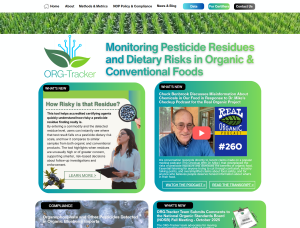
To keep abreast of the latest data that can be drawn upon in comparing pesticide residues and dietary risk levels in organic and conventional food, visit the ORG-Tracker website. ORG-Tracker is a project of HHRA that entails integrating and comparing residue data generated by organic certifiers with the USDA’s annual data on residues in conventional and organic foods.
If the public health and organic food and farming communities are going to counteract the growing flood of disinformation on the health benefits of organic food and farming, many more people need to invest the time required to understand the underlying issues and how science can now pinpoint with considerable accuracy where many of the worrisome residues lurk in the U.S. food supply.
Otherwise, we will remain reliant on current policy and protocols, a strategy akin to shooting a moving target in the dark.