
- Why HHRA’s Amicus Brief to the Supreme Court in Opposition to Preemption?
By: Tom Green, HHRA Board Chair Pesticides are critically important tools for public health and for our food, fiber and fuel supplies. They’re important in all kinds of agriculture including organic. I’ve devoted my career to pursuing safer use of pesticides, and only when alternative approaches are not adequate. I’ve worked with all types of producers and crops, and homeowners, managers and others in all types of facilities and landscapes in more than 50 countries! I’m very grateful for the career I have had, and for the work I continue to be fortunate to do as board member in several organizations, and as operator of my own local “green” pest control business in Madison, Wisconsin. I’ve witnessed tremendous progress in reducing pesticide risk over my 50-year career. Progress has been made as a result of efforts and commitment by all sectors, including manufacturers, distributors, advisors, advocates, regulators, researchers and users. However deep-set, systemic problems continue in how pesticides are discovered and brought to market, tested, regulated, and used. Avoidable risks persist for many reasons including lack of effective, affordable alternatives for some high risk uses, and insufficient public investment in research, education, training, and incentives to support users to transition to less risky alternatives. Regulatory oversight can also be inadequate, with manufacturers able to delay final action to lower exposures six ways to Sunday, and new scientific methods and higher quality data from outside the industry languishing on the sidelines. In 2015, Monsanto found out what happens when a company loses control of the narrative about the safety of one of its flagship products. In that case, it happened with the world’s most widely used pesticide ever, glyphosate. This is the broad-spectrum herbicide commonly referred to as Roundup. This product has been overused so broadly that now more than 50 species of weeds are resistant – no longer able to be controlled by glyphosate. A monumental series of events was set in motion in March of that year when the International Agency for Research on Cancer defied expectations and classified glyphosate as a “probable” human carcinogen. Those events swept up HHRA’s founder and pesticide-policy expert Chuck Benbrook in what has turned into over 10 years of work as an expert witness for plaintiffs in the Roundup-non-Hodgkin lymphoma litigation. It drove Bayer/Monsanto to finance and orchestrate a high-dollar campaign to more fully shield itself, and other pesticide manufacturers, from liability when a product harms people or triggers economic losses for farmers. In 2025, the industry effort to change state law played out simultaneously in nearly a dozen state capitals, in the US Congress, in federal agencies, at the White House and in the courts. And now, a main event is about to unfold – the pesticide industry’s long-awaited, second attempt to get the Supreme Court to rewire the Federal Insecticide, Fungicide and Rodenticide Act (FIFRA) to erect a liability shield for the industry, and end a meaningful role for individual states wanting to supplement federal regulations to address high-risk pesticide uses in their states. Amicus Briefs are due April 1. Oral arguments is set for April 27th. A decision is expected by early summer, just in time to assure passions over pesticide preemption will likely influence the outcome of midterm elections in perhaps a dozen rural House districts, and maybe even a few Senate races in major farm states. If the Court rules in favor of pesticide manufacturers, we will all have to hope that the stronger, more focused and consolidated pesticide industry will work responsibly with federal EPA to make sure everything is just-about-perfect on all pesticide product labels. To the extent labels fall short and fail to address possible “unreasonable adverse effects”, people can get upset at the EPA, but seeking compensation from industry in the courts will become a much steeper climb. Heartland Health Research Alliance’s Amicus Brief explains to the Court why farmers, and other people who have to control pests as part of their jobs, or to protect their livelihood or loved ones, will pay the biggest price. When things go south and problems arise, the new mantra will be the “buyer should have been aware.” This is the industry’s second major run at the Supreme Court in the hope of putting preemption in place as the “law of the land”. Despite several industry efforts, Congress has never passed such a law. Quite the opposite, Congress has built modern FIFRA on the back of a multi-dimensional federal-state partnership. The first major Supreme Court attempt started in 2001 when a small group of Texas peanut farmers politely asked Dow Agrosciences to cover their losses when Strongarm, a new Dow herbicide, damaged their crop, triggering significant financial losses. Dow refused. The farmers went into state court and won. Appeals up the legal good chain followed, ending in the Supreme Court in 2005. The Court sided with the farmers in the now infamous Bates v. Dow Agrosciences case. The Court’s Order clarified and preserved the role of states, and did not erect the long-sought liability shield. It is ironic that farmers and farm organizations are among the most politically active in pushing preemption now, despite the fact it was a determined bunch of Texas farmers who refused to back down, and through their actions, make it possible for contemporary farmers to win compensation when a pesticide does not do its job. We tried to understand what was behind this odd turn of events. The only answer that made any sense was that farmers did not understand where current policy came from, nor what a change of policy will mean for them going forward. Our Amicus Brief is crafted to help farmers, and hopefully the justices too, better understand how we got here, what is driving this campaign, and who will pay the piper if the industry prevails.
- Making Homegrown Produce Safer Belongs on the MAHA Agenda
HHRA’s major project, the Heartland Study, is designed to determine whether prenatal exposures to pesticides, and especially herbicides, are contributing to problems during pregnancy like preeclampsia, preterm birth, or developmental abnormalities. We already know that a healthy diet reduces the risk of preeclampsia and helps support normal fetal development. A healthy daily diet for pregnant persons contains several servings of fresh fruits, vegetables, and nuts, and avoids more than a few servings of ultra-processed foods high in added sugar, salt, and fats. The newly issued Dietary Guidelines for Americans reinforces the long-standing recommendation for the average person to at least double daily intakes of mostly fresh produce. To make America healthy again, the nation must make the investments necessary to more than double fruit and vegetable production. Imports will help meet some winter-season demand for fresh fruits and vegetables, but nutritional quality and safety problems have proven hard to effectively curtail. Each year we assess pesticide residues in food using HHRA’s Dietary Risk Index (DRI) system. The data consistently show that imports account for most of the high-risk samples of produce entering the U.S. food supply. Access the imports vs. domestically grown food module in the DRI to compare residues and risk levels by food and country of origin over the last 35 years. While the public is focused on other critical investment and infrastructure challenges in the energy, healthcare, and manufacturing sectors, far too little attention is directed at what it will take to double – or better yet – triple domestic production of health-promoting fruits, vegetables, and nuts. In short, a lot. It will require changes in farm policy to free up land. Changes in federal and state water policy to redirect precious irrigation water supplies in the west to grow more nutrient-dense, human foods and less low-value crops used to feed livestock. Massive investments in storage, processing, and distribution infrastructure will be required. But perhaps even bigger and more costly changes will be needed to secure a stable workforce. This will require changes in immigration policy, coupled with a new-found willingness to invest in farmworker housing, and stable and rewarding career paths for those working on farms. Adding another 15 to 20 million acres of high-value fruit, vegetable, and nut production, and accommodating all the other essential changes, will require billions in public sector investments, and many billions more in private investment. It won’t happen just because industry leaders and politicians say it should. Let’s hope we proceed down this road with a clear sense of the goals and what it will take to achieve them. Improving the safety of fresh produce is surely near the top of this list. Two big changes will be needed to build markedly higher margins of safety into our food system: To prevent the flow of pathogens from livestock operations into fresh produce fields, assuring at least a few miles separate fresh produce fields and Concentrated Animal Feeding Operations, and Making organic production the most profitable option for farmers as they expand acreage devoted to fresh fruit and vegetables. The scientific case for getting high-risk pesticide residues out of foods consumed by pregnant women, infants, and children was articulated clearly in the 1993 NAS report Pesticides in the Diets of Infants and Children. Scientific insights gained in the last 32 years have markedly broadened understanding of the range of benefits that will follow a switch to mostly organic fresh produce. Our Heartland Study and other HHRA research will shed new light on which pesticides, used where and why, are contributing to adverse health outcomes. Such insights will then make it possible to target ongoing investments in testing, enhancing infrastructure, and farming system changes needed to grow the supply of organic fresh produce and incrementally drive down production and distribution costs. But one outcome is virtually certain. Reducing pesticide dietary exposures will improve public health outcomes, and across the U.S. population, the benefits will be greatest during pregnancy and the early stages of life. But not everyone agrees. Some scientists still argue that there are no meaningful differences in pesticide use and risks on organic farms in contrast to nearby conventional farms growing the same crops. Unfortunately, there is ample financial support accessible to people defending pesticides, and trying to belittle the benefits of organic farming. There are also career advancement benefits, like industry-funded positions in public universities and not getting fired for following the data and speaking the truth. Better and more data, and more people who understand the issues and current science are needed to effectively counter the narrative that organic farming delivers no public health benefits. In the current information ecosystem, the organic community should not take for granted that people “get it”. The differences in residues and risk levels in organic versus conventional foods are so large that stating otherwise should not pass anyone’s laugh test. Pesticide use and dietary risks in conventionally grown crops often exceed the levels in corresponding organic foods by several-hundred fold. Conventional row-crop farmers are now spraying four or more herbicides per acre to get a crop to harvest on 98% of planted acres, whereas organic row-crop farmers use other methods to manage weeds. On the very small percent of organic row-crop acres that are sprayed, only a single bioherbicide is applied. For many fruits and vegetables, and especially those with soft skins and no peel, most of the high-risk residues finding their way into the U.S. food supply are on or in imported produce. Relatively few high-risk samples are conventionally grown in the U.S. Almost none are organic, and most of the very few high-risk organic samples are imported. Is there a pattern in these data? Yes, nearly all U.S. grown conventional and organic food is markedly safer than corresponding imports. This is why the nation should reduce reliance on imported fresh produce as we double, and eventually triple domestic production. I participated in a Real Organic Project (ROP) podcast chasing these issues deep down many rabbit holes. The host, Dave […]
- V.2 of FEVER Act Posted for Comments
Note to Readers and FEVER Act Contributors From: Chuck Benbrook, HHRA Consultant On this first day of 2026, we are pleased to share V.2 of the “Farm Economic Vitality and Environmental Recovery Act” (pdf of V.2 FEVER Act). The text of V.2 appears at the end of this message. The V.1 draft of the Act is posted on the HHRA website, along with an October 26, 2025 blog explaining what we hope to accomplish in the crafting of a comprehensive bill to reform food and ag policy. Subsequent versions of the FEVER Act will be posted on the HHRA website chronologically on the FEVER Act Drafts. Each version will begin with a summary of changes made and new issues addressed. In V.2, several provisions are dropped from V.1 that were included as a way to begin implementing policy reforms as part of the increase in subsidies paid to row crop farmers in the One Big Beautiful Bill (OB3). These provisions added near-term administrative complexity that is no longer needed or relevant. On December 10, 2025, the USDA announced a new, $700 million investment in regenerative ag systems via a novel, NRCS-administered program. This unexpected, but welcomed development puts in place a streamlined process to provide farmers support for multi-practice, integrated changes in farming systems with potential to enhance soil health, water quality, and capture carbon in the soil. USDA officials have stressed it is just a first step, in effect, a down payment in support of more systemic changes. In FEVER Act V.2, provisions are added that combine the current provisions in the $700 million NRCS program with also-needed changes in farm commodity program payments and crop insurance policy. The changes are designed to: Break the policy-driven chains holding back ag innovation and progress in improving soil health and public health, Allow farmers to diversify rotations, thereby expanding the supply of crops that can be profitably grown in the U.S. but are now imported in substantial volumes, Reduce surpluses of the most generously supported commodity crops so recurrent payments go down in support of those crops, freeing up money to invest in other priority needs, Accommodate the shift of approximately 15 million acres now devoted to commodity crops to fruits, vegetables, and nuts in order to MAHA, and Address western water and midwestern crop diversification needs simultaneously through incremental shifts in the production of water-intensive livestock feed crops from the western U.S. to the east and northern tier states. Please email ideas to add to or improve the policy proposals in the FEVER Act to Chuck Benbrook. Concrete, specific changes in the policy reforms discussed below will be most helpful, in addition to policy reforms not yet addressed in the below document. V.2 of the FEVER Act Goals of the “Farm Economic Vitality and Environmental Recovery Act” (FEVER Act V.2): Significant improvements in soil health and environmental quality, profitability on the farm, rural community vitality, and public health will require systemic reforms in laws, policy, regulation, and public expenditures. The need for change is growing ever-more obvious in step with rising reliance on bailouts for crop farmers, and advancing metabolic syndrome, chronic disease, and reproductive problems. At some time in the future, the demand for change will coincide with political dynamics and openness to change. This document outlines the policy reforms, changes in law and regulation, and shifts in taxpayer investments via subsidies and favorable tax policy for farmers and the food industry. The changes outlined herein will be almost certainly be required to make a substantial difference in how food is grown, processed, and sold in the U.S., especially if the goal is to achieve such changes within a generation. The needed transformation of the American food system could progress smoothly, and require a redirection of government spending, as opposed to increases. The extent to which essential reforms are adopted simultaneously, and implemented wisely, will drive progress in achieving common goals grounded in health outcomes for animals and people, for the soil and environment, and for rural communities. Reforms will be required in multiple areas of law and policy, including some that have not traditionally been part of five-year farm bills. Hence, the FEVER Act addresses reforms that fall outside past farm bills. It strives to provide a comprehensive backbone of policy change sufficient to alter the performance and nature of food and farming in the U.S. over one to two generations. Chapter 1. Commodity Program Enrollment Options, Requirements, and Payment Rates. 3 Producers Not Enrolling in BAR&P Contracts. 6 Producers Enrolling in BAR&P Contracts. 7 Funding and Payment Limitations 8 Chapter 2. Crop Insurance and Disaster Payment Programs. 10 Altering the Yield Goals Embedded in Crop Insurance Contracts 10 Disaster Payment Programs. 11 Chapter 3. Soil and Water Conservation and Promotion of Soil and Environmental Quality. 11 Defining and Measuring Soil Health. 11 Need for Improved Indicators. 12 Chapter 4. Promoting Competition.. 13 Taking Stock of Relative Profitability and Economic Sustainability 13 Moratorium on Mergers and Acquisitions Until the FTC Confirms the Absence of Anti-competitive Activities and Market Dynamics 13 Chapter 5. Policy Reforms and Strategic Investments in Sustainable Animal Production Systems. 14 Goals and Metrics for Tracking Progress. 15 Availability of sufficient land to apply manure at an agronomically and environmentally “best practice” rate. 16 Promoting forage-based rations and grazing systems to enhance soil and animal health, lower production costs, and assist producers in diversifying rotations. 16 Monitoring and mitigating movement of nitrogen from livestock operations. 17 Diversifying Market Opportunities for Primary Producers 18 Chapter 6. Enhancing the Nutritional Quality and Safety of the U.S. Food Supply. 18 Chapter 7. Food and Agricultural Trade. 21 Chapter 8. Enhancing the Contribution of Biofuels in Meeting National Needs. 22 Appendix A. Provisions in the 2017 Soil Health and Income Protection Program (SHIPP) 25 Appendix B. About the Federal Food Administration Act. 26 Chapter 1. Commodity Program Enrollment Options, Requirements, and Payment Rates Commodity program, crop insurance, and conservation policy provisions in the FEVER Act strive to achieve […]
- About the Current Farm Crisis and the Scope of Farm Bill Reforms Necessary to Bring About Meaningful Change
By: Tom Green, HHRA Board Chair and Chuck Benbrook, former HHRA ED Updated December 13, 2025 Farmers growing major U.S. crops including corn, soybeans, wheat, rice, cotton and peanuts are facing record loses due to steeply depressed crop prices over the past few years, coupled with persistently rising production expenses and disruptions in trade flows. Today’s cost-price squeeze poses an existential threat for many farmers and all rural communities. Experts are projecting that per acre loses will likely exceed $100 an acre on many farms in 2025, and will likely deepen in 2026, with no end in sight under current policy and market conditions. HHRA decided to compile and vet food and ag policy reforms to change the trajectory of U.S. agriculture and the food industry for two reasons. First, the provocative September 30, 2025 piece by Chris Bennett in AgWeb entitled “Outraged Farmers Blame Ag Monopolies as Catastrophic Collapse Looms”. The frustration expressed, and pleas for help in getting through the current crisis, struck a nerve. We urge everyone to read this piece. Second, as anyone working in food and ag is well aware, new tariffs imposed by the U.S. essentially shut off, or dramatically reduced, sales of soybeans, corn, and some other crops to major overseas customers. This has further undercut already depressed market prices, leading to ballooning surpluses. It has also triggered the need for another round of multi-billion dollar payments to farmers, via the just-announced $12 billion in new payments that are intended to serve as a “bridge” to more favorable prices and income dynamics . But U.S. income dynamics are inexorably linked to developments around the world. In particular, Brazil and Argentina have made steady strides in lowering the cost of growing, transporting, and shipping soybeans and corn to China and other Pacific Rim countries. Both countries are now able to offer growing volumes at prices well below U.S. costs of production plus transportation. Bad weather or other disruptions in production will no doubt drive market prices back upward in some years, but long-term trends are clear and their implications are sobering: without incrementally higher public subsidies per bushel of corn and soybeans, U.S. farmers are now largely priced out of international markets, and will remain so even if and as trade policy shifts back toward the unimpeded flow of goods and services around the world. As a result, something has to give. Major policy reforms will become essential to avoid cataclysmic impacts on current-generation farmers and ranchers, and rural America. We decided to craft and share the “Farm Economic Vitality and Environmental Recovery (FEVER) Act” because there is little or no serious discussion among ag community leaders, policy experts, or in the Congress, of the systemic reforms in policy needed to avoid ever-larger bailouts in the not-too-distant future. The large sums of taxpayer money at play — over $40 billion in farm support in 2025, and likely even more in 2026 — heighten the urgency of reaching agreement on substantive policy changes. The pressing challenge is to not invest taxpayer dollars during 2026 and beyond in bigger and better bandaids, but instead in support of the deeper, systemic changes in farming systems that most farmers, advocates for healthier rural communities, scientists, and policy wonks know are needed. Given today’s political and economic realities, it is hard to imagine that the Congress and Administration will be able to increase payments to farmers enough to prevent unacceptable loses and turmoil in rural America. Within a day of the announcement of another $12 billion in emergency aid, commodity and farm organization leaders started stressing the need for more aid by mid-2026. Leading up to midterm elections in November 2026, the Administration and Congress are unlikely to support further cuts in SNAP and other food security programs to free up money for another infusion of taxpayer support delivered via existing farm commodity programs. Strong, bipartisan support will be needed to appropriate significant new funding to support farmers in 2026. One promising path, or formula, to create such support is open debate about the systematic policy reforms needed to effectively address the underlying problems with current farm commodity and crop insurance programs, reforms like those called for by the farmers quoted in Chris Bennett’s piece. We are working to vet and continuously improve the FEVER Act in the hope it provides farmers, farm organizations, and policy leaders some fresh thinking and new ideas about how to solve at least some of the long-term, policy-driven problems. At the top of the list are aspects of food and ag policy that are tying the hands of farmers who see a need to change, enhance soil health, and MAHA, but cannot afford to move ahead because agronomically needed and sound changes would lead, over time, to less financial support from existing commodity and crop insurance programs. As made clear in thoughtful assessments by Bloomberg of the current economic and environmental crises facing rural America, farmers want to earn their living from markets, and end reliance on government bailouts. They also want to receive sufficient income to invest steadily in the people running and working on their farms, as well as in system changes that will enhance soil health and water quality. History Does Repeat Itself Until… The current crisis continues the long-standing pattern of gradual decline in farm numbers and farm profitability. Stubborn downward trends are punctuated by sharp, episodic cycles in the U.S. farm economy that, when prices tank relative to trend, require new bailouts and subsidy streams. Poor stewardship of our ag assets is reflected in the loss of so many U.S. farms since 1980, including 160,000 since 2017, coupled with ongoing slippage in profitability, soil health, and water quality. Our food and farming problems are complex and intertwined, and rooted in policies far past their “best used by” date. Fixing problems that have worsened over decades will take time and money, both of which are in short supply. Hence, the need for aggressive and innovative policy reforms. Think […]
- Farm Economic Vitality and Environmental Recovery Act (FEVER Act): Discussion Document
By: Tom Green, HHRA Board Chair and Chuck Benbrook, former HHRA ED Note to Readers and Contributors The document below discusses policy reforms that could be incorporated in future farm legislation. We are soliciting reactions and better ideas to improve what we are calling the “Farm Economic Vitality and Environmental Recovery Act” (FEVER Act). The current version of the FEVER Act document is posted on the HHRA website at hh-ra.org/2025-MiniFarmbill. It describes a set of food, farm, and regulatory policy reforms of the scope and scale required to bring about meaningful change in the U.S. food and fiber system. At this time, the document covers changes primarily in the commodity program, crop insurance, and conservation sections of the farm bill. Reforms and funding needed in the SNAP and food assistance programs, research and extension, rural development, and in most USDA-administered marketing and regulatory programs are not yet included in the document. Reforms needed in certain areas of regulatory and food policy law will also be addressed in future additions. The policy reforms in this document are focused on immediate national priorities. These include: Getting farmers through the current net income crisis, while avoiding harm or undercutting farms and ranches that remain profitable, despite contemporary headwinds, Providing justification for what is likely to be a historically significant increase in taxpayer support for farmers over the next 5 to 10 years, Reducing dependence on government subsidies, bailouts, and food imports, and especially those that perpetuate the primary drivers of today’s systemic problems, Modernizing pesticide regulation, food nutritional quality testing and labelling, and the National Organic Program, and most fundamentally, Assuring that the primary purpose, and major focus of government expenditures, is restoring soil health and public health and well-being, as opposed to sustaining farming systems and technology, and business models, that have become progressively less economically viable and socially acceptable. This is an organic document that will change and evolve regularly as new and better ideas are advanced. HHRA has developed the FEVER Act to integrate and sharpen policy reforms designed to meet the needs of the day. Please email any ideas to improve the policy proposals and suggestions in the FEVER Act to former HHRA ED Chuck Benbrook (cbenbrook@hh-ra.org). Concrete, specific changes in the policy reforms discussed below will be most helpful, in addition to policy reforms not yet addressed in the below document. Goals of the “Farm Economic Vitality and Environmental Recovery Act” (FEVER Act): Help farmers navigate steep market loses on commodity crops in the near-term, while beginning essential transitions in cropping systems, farm commodity and crop insurance policies, water use and quality, and food security and farm economic sustainability. Assure taxpayer dollars are invested in ways that will restore farmer and rancher profitability per unit of production, regenerate soil health, strengthen rural communities, and promote public health. Diversify crop rotations and income streams by reducing reliance on imports and heavily subsidized commodity crops. Phase out subsidies providing incentives for farmers to pursue excessively-high yield goals that result in production costs per unit above global market prices. Incrementally lessen subsidies, bailouts, and disaster payments, and increase farm financial security by raising the share of gross farm and ranch revenue received from competitive markets. Finance needed commodity program and water use changes required to shift regional farm production patterns with initial focus in 2026-2030 on reducing by at least one-half the acres devoted to the production of low-value, water-intensive animal feed crops in the arid west. Base Acre Land Use and Policy Changes In each of the next five crop years (2026-2030), farmers managing base acres in commodity programs may enter into “Base Acre Renewal and Profitability Contracts” with the USDA. The terms of such contracts shall include: Plant at least or a grass or legume forage crop.[1] The acres planted to such crops on a given field must differ year to year, resulting in at least one year of soil building crop on a minimum of 60% of a farm operation’s base acres over the three-year contract period. Farmers may propose planting greater than 20% of commodity program base acres in cover and forage-based crops, and will become eligible for incentive payments per acre. Such incentive payments shall be set at the local level in accord with regional guidance, and shall fall between 10% and 20% of the applicable payment in the absence of an agreement to increase the percentage of commodity program base acres planted to cover or soil building forage crops. Farmers shall manage cover or forage crops in ways that assure weed suppression benefits, improved water quality, and soil health benefits, and in compliance with local requirements and guidelines issues by county committees and in accord with USDA requirements. Farmers may graze or harvest cover and soil-building forage crops, and extend the period a field is producing a cover or forage crop beyond the three-year program in accord with payment rates and requirements specified by Congress and the USDA in future legislation. Within 30 days of signup, farmers will receive year-one payments equal to 150% of their established payment per commodity program base acre in 2026. Hereafter, such payments are referred to as “enhanced program payments”. Up to 50% of the enhanced payment made in the first quarter of 2026 shall be deducted from any future Agricultural Risk Coverage (ARC) and/or Price Loss Coverage (PLC) payment due to the farm operation in the last quarter of 2026 as a result of provisions in the OBBB. (Example: Base commodity program payment per acre = $100. Enhanced payment = $150/acre. If $80/acre is due to be paid under ARC/PLC in the fall of 2026, the USDA would deduct 50%, or $40/acre from the ARC/PLC. This provision allows for earlier payment of ARC/PLC payments due in 2026, while reducing a portion of overlapping and additional payments). Farmers who fail to adhere to contractual obligations calling for the planting of soil building cover or forage crop, or the management of soil building crops at any point during the contract […]
Helping Americans Choose Healthier Foods: If There is the Will, There is a Way
By: Tom Green, HHRA Board Chair and Kathleen Merrigan, Chair, Policy Advisory Committee
Excessive intakes of unhealthy processed foods are driving deeply worrisome trends in public health that every American family is aware of, and likely impacted by. Problems arising in the wake of industrial-scale, processed food manufacturing have grown steadily more severe over the last half century.
On October 16th, the New York Times published “How America Got Hooked on Ultraprocessed Food”. It catalogues how processed foods have come to dominate caloric intake in 2025. Coca-cola was first marketed in 1886. Remember Tang, and the 8 ways Wonder Bread builds strong bodies?
The public is now painfully aware that their food choices matter. But to drive change, eaters need credible, consistent, and actionable information on which foods are healthy, and not so healthy, and just plan unhealthy.
If this is done without sugar-coating and soft-peddling, the stage will be set for rapid progress. But providing consumers such information will be vigorously contested by those currently profiting from nationwide sales of many UPF brands.
An Evolving MAHA Priority
The FDA and USDA published a request for public guidance on how to identify UPFs in July. HHRA and the Swette Center convened a diverse team to write the UPF comments that have just been submitted to the FDA-USDA.
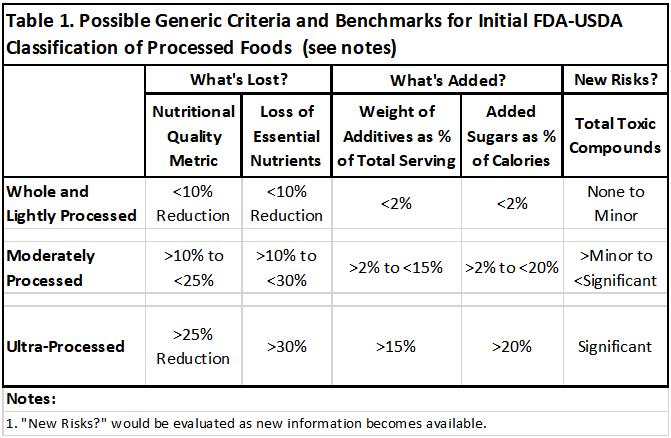
Our comments urge the government to define and quantify the impacts of food processing through the lens of public health. Doing so will require three metrics. A first to quantify the nutrients lost as raw ingredients are converted into finished processed foods.
A second “What’s Added?” metric to reflect the quantity of supplemental nutrients added into a finished food product, typically to replace nutrients lost in milling and processing. And a third “New Risks?” metric to capture, to the extent possible, the degree to which processing creates new, or increases existing, food safety risks, or adversely alters nutrient bioavailability.
Our food processing comments explain how the above metrics can be calculated, and then drawn upon in classifying processed foods in terms of healthfulness. Table 1 below summarizes a way such metrics could be used in delineating zones along a continuum of food processing impacts.
Our food processing comments build on earlier comments to the FDA.
February, 2023 comments by HHRA and the Swette Center responded to a FDA proposed rule on how to define and quantify food nutritional quality.
We recommended that nutritional quality be quantified using a metric that takes into account the number and concentrations of health-promoting nutrients in a serving of food, coupled with caloric content.
A second set of HHRA-Swette Center comments was submitted to the FDA in July, 2025. These comments responded to another proposed rule focused on how to optimally communicate nutritional quality information via front-of-package (FOP) labeling. We recommended the FDA require FOP labeling based on the nutritional quality and processing metrics in what we call the “NuCal” system.
Optimal Delivery of Nutritional Quality and Processing Information
A study published just this month in JAMA Network Open compared six options for delivering nutritional quality information. These included the FDA’s 2025 proposal, combinations of “High In” and other positive messages, and what is called a “spectrum” label.
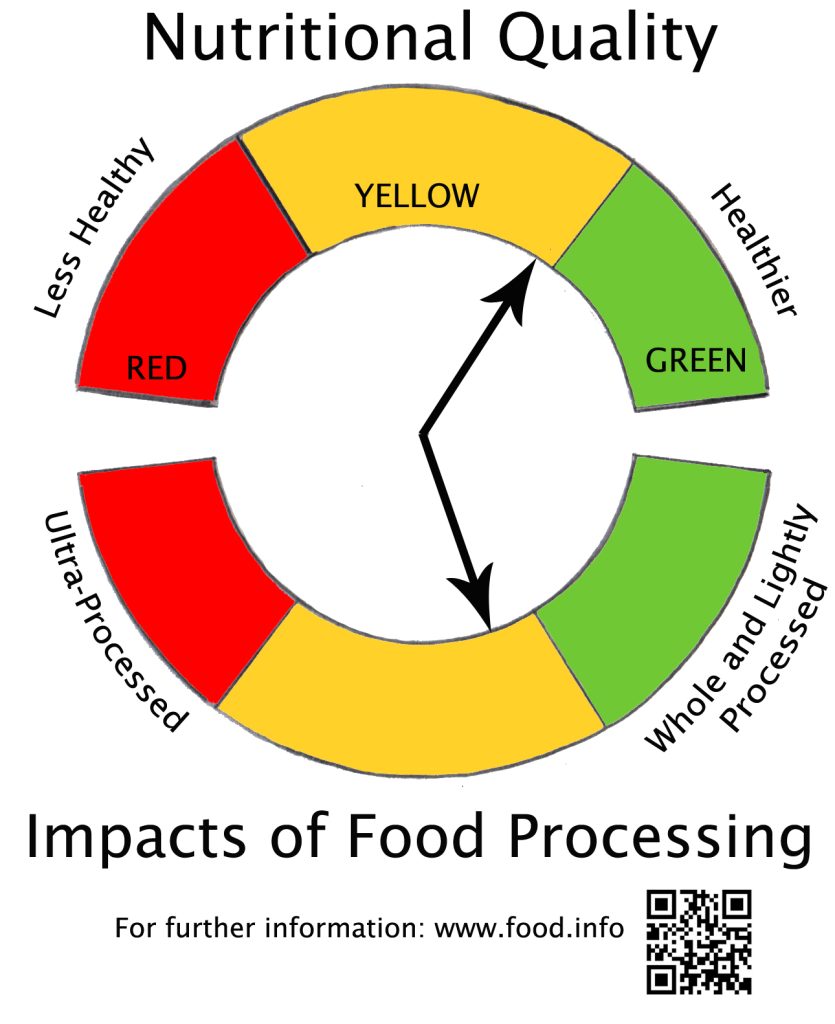
The spectrum option utilizes a single, integrated measure of nutritional quality that takes account of both positive attributes (e.g., “high in calcium” or “promotes heart health”), as well as negative factors (e.g., excessive added salt, sugar, or fat). .
The recent study concludes that spectrum labels were the most effective, and that none of the other five options led to healthier food choices.
In our just-submitted comments, we recommend just such a “spectrum” metric and graphic display to convey both nutritional quality and food processing information, as shown below.
The government is likely to issue another proposed rule by mid-2026 on FOP labelling and classifying foods by degree of processing.
HHRA and the Swette Center look forward to the next proposal advanced by the FDA-USDA.
We will again share our thoughts and recommendations on how the government can put in place new systems and labelling that will enhance the nutritional quality and safety of the U.S. food supply, and hopefully, the sooner the better.
Sources and Further Information
“Defining and Delineating Ultra-Processed Foods,” HHRA and Swette Center comments to the FDA-USDA submitted October 21,2025.
“Nutrition Info and Other Front-of-Package Labels and Simulated Food and Beverage Purchases: A Randomized Clinical Trial”, Grummon et al., JAMA Network Open. 2025 Oct. doi: 10.1001/jamanetworkopen.2025.37389.
“Enhanced Labeling to Promote Consumption of Nutrient Dense Foods and Healthier Diets”, Benbrook and Mesnage, Foods, 2024. doi.org/10.3390/foods13213377.
“GRAS NOTIFICATION FOR SOY LEGHEMOGLOBIN PROTEIN PREPARATION DERIVED FROM PICH/A PASTORIS”, Submitted by Impossible Foods to the FDA.