
By: Tom Green, HHRA Board Chair and Chuck Benbrook, former HHRA ED
Note to Readers and Contributors
The document below discusses policy reforms that could be incorporated in future farm legislation. We are soliciting reactions and better ideas to improve what we are calling the “Farm Economic Vitality and Environmental Recovery Act” (FEVER Act).
The current version of the FEVER Act document is posted on the HHRA website at hh-ra.org/2025-MiniFarmbill. It describes a set of food, farm, and regulatory policy reforms of the scope and scale required to bring about meaningful change in the U.S. food and fiber system.
At this time, the document covers changes primarily in the commodity program, crop insurance, and conservation sections of the farm bill. Reforms and funding needed in the SNAP and food assistance programs, research and extension, rural development, and in most USDA-administered marketing and regulatory programs are not yet included in the document. Reforms needed in certain areas of regulatory and food policy law will also be addressed in future additions.
The policy reforms in this document are focused on immediate national priorities. These include:
- Getting farmers through the current net income crisis, while avoiding harm or undercutting farms and ranches that remain profitable, despite contemporary headwinds,
- Providing justification for what is likely to be a historically significant increase in taxpayer support for farmers over the next 5 to 10 years,
- Reducing dependence on government subsidies, bailouts, and food imports, and especially those that perpetuate the primary drivers of today’s systemic problems,
- Modernizing pesticide regulation, food nutritional quality testing and labelling, and the National Organic Program, and most fundamentally,
- Assuring that the primary purpose, and major focus of government expenditures, is restoring soil health and public health and well-being, as opposed to sustaining farming systems and technology, and business models, that have become progressively less economically viable and socially acceptable.
This is an organic document that will change and evolve regularly as new and better ideas are advanced. HHRA has developed the FEVER Act to integrate and sharpen policy reforms designed to meet the needs of the day.
Please email any ideas to improve the policy proposals and suggestions in the FEVER Act to former HHRA ED Chuck Benbrook (cbenbrook@hh-ra.org). Concrete, specific changes in the policy reforms discussed below will be most helpful, in addition to policy reforms not yet addressed in the below document.
Goals of the “Farm Economic Vitality and Environmental Recovery Act” (FEVER Act):
- Help farmers navigate steep market loses on commodity crops in the near-term, while beginning essential transitions in cropping systems, farm commodity and crop insurance policies, water use and quality, and food security and farm economic sustainability.
- Assure taxpayer dollars are invested in ways that will restore farmer and rancher profitability per unit of production, regenerate soil health, strengthen rural communities, and promote public health.
- Diversify crop rotations and income streams by reducing reliance on imports and heavily subsidized commodity crops.
- Phase out subsidies providing incentives for farmers to pursue excessively-high yield goals that result in production costs per unit above global market prices.
- Incrementally lessen subsidies, bailouts, and disaster payments, and increase farm financial security by raising the share of gross farm and ranch revenue received from competitive markets.
- Finance needed commodity program and water use changes required to shift regional farm production patterns with initial focus in 2026-2030 on reducing by at least one-half the acres devoted to the production of low-value, water-intensive animal feed crops in the arid west.
Base Acre Land Use and Policy Changes
In each of the next five crop years (2026-2030), farmers managing base acres in commodity programs may enter into “Base Acre Renewal and Profitability Contracts” with the USDA. The terms of such contracts shall include:
- Plant at least or a grass or legume forage crop.[1] The acres planted to such crops on a given field must differ year to year, resulting in at least one year of soil building crop on a minimum of 60% of a farm operation’s base acres over the three-year contract period.
- Farmers may propose planting greater than 20% of commodity program base acres in cover and forage-based crops, and will become eligible for incentive payments per acre. Such incentive payments shall be set at the local level in accord with regional guidance, and shall fall between 10% and 20% of the applicable payment in the absence of an agreement to increase the percentage of commodity program base acres planted to cover or soil building forage crops.
- Farmers shall manage cover or forage crops in ways that assure weed suppression benefits, improved water quality, and soil health benefits, and in compliance with local requirements and guidelines issues by county committees and in accord with USDA requirements.
- Farmers may graze or harvest cover and soil-building forage crops, and extend the period a field is producing a cover or forage crop beyond the three-year program in accord with payment rates and requirements specified by Congress and the USDA in future legislation.
- Within 30 days of signup, farmers will receive year-one payments equal to 150% of their established payment per commodity program base acre in 2026. Hereafter, such payments are referred to as “enhanced program payments”. Up to 50% of the enhanced payment made in the first quarter of 2026 shall be deducted from any future Agricultural Risk Coverage (ARC) and/or Price Loss Coverage (PLC) payment due to the farm operation in the last quarter of 2026 as a result of provisions in the OBBB. (Example: Base commodity program payment per acre = $100. Enhanced payment = $150/acre. If $80/acre is due to be paid under ARC/PLC in the fall of 2026, the USDA would deduct 50%, or $40/acre from the ARC/PLC. This provision allows for earlier payment of ARC/PLC payments due in 2026, while reducing a portion of overlapping and additional payments).
- Farmers who fail to adhere to contractual obligations calling for the planting of soil building cover or forage crop, or the management of soil building crops at any point during the contract period, shall be penalized in an amount n less than 10%, and up to 60% of the next scheduled ARC/PLC payment per acre. At the discretion of the USDA and county committees, such a reduction in payments may be adjusted and split over two years.
Base Acre Payment Rate Adjustments
Balancing Production to Market Demand and Assuring Profitable Prices to Free Up Baseline expenditures for New Program Priorities
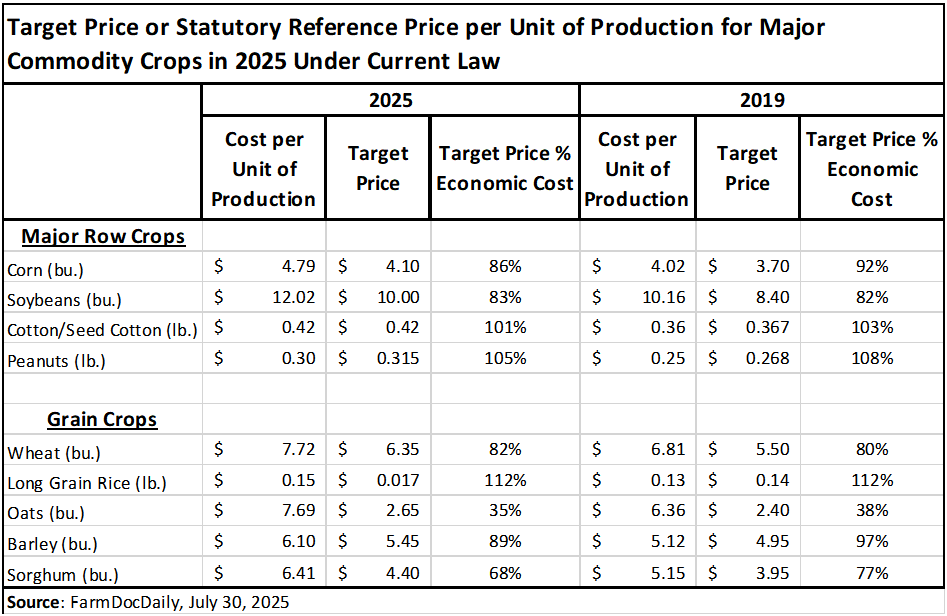
In each of the next five years (2026-2030) and for all currently covered commodities, base acre target/reference prices shall be reduced annually by at least 5%, for a total five-year reduction of not less than 25%. The table below presents target price and cost of production data on major commodity crops for 2025 and 2019, as compiled by the farmdoc team.
For crop year 2031 and beyond, the USDA shall incrementally adjust base acre yield levels to the level at which farmer net returns per unit of production are expected to be maximized based on historical trends in costs of production and yields. Annual adjustments may not exceed 5% in any given year in the per acre yields used in determining farm program payments per acre.
Reducing Reliance on Imports and Promoting Crop Diversity and Soil Health
To address historic imbalance in the target price levels for major program crops (corn, soybeans, cotton, wheat, long grain rice, peanuts, oats, barley, sorghum), to diversify crop rotations, and to reduce reliance on imports, the statutory target/reference price for oats, sorghum, barley, and other qualifying “Emerging and Low-Acreage Crops” (defined below), shall be increased and/or established by region to a level sufficient by to expand production by 2030 such that imports of each covered commodity account for no more than 10% of total U.S. market demand (exported crops would not be included in calculation of U.S. market demand).
If the USDA determines that US growers are not likely to increase production sufficient to meet at least 90% of domestic demand for such “Emerging and Low Acreage Crops”, the Department shall increase target prices, per acre yield rates, or make other adjustments in commodity and crop insurance programs and as needed to achieve the 90% self-sufficiency goal by end of the 2030 crop season. In doing so, the USDA is directed to take into account the need to adjust target and statutory reference prices in accord with international trade agreements, production costs among competitors, and market dynamics. Annual decreases in target and statutory reference prices may not exceed 10%.
Emerging and Low-acreage Crops
In order to promote economic diversification in rural America, meet growing demand for nutrient-dense human food crops, and enhance soil health, the USDA shall identify by region a list of “Emerging and Low-acreage Crops” for which target/reference prices will be established, and adjusted as needed, to attain annual production and self-sufficiency goals.
In order to narrow the now sizable gap between U.S. production and demand for organically grown crops and animal feed, the USDA is directed to establish target/reference prices and base acre allotments for organically grown corn, soybeans, wheat, oats, barley, sorghum, and other significant “Emerging and Low-acreage Crop”.
Farmers wishing to convert existing commodity program base acres to organic management in compliance with approved Organic System plans shall be allowed to do so, and may qualify for incentive payments during the three-year transition to certified organic production. Such transition payments, and the provisions governing continued enrollment of former commodity base acres now managed organically, are described in the section discussing “Base Acre Transition and Retirement Program”.
If needed in light of Congressional appropriations, funds to cover projected increases in commodity program payments for certain crops shall be covered by mandatory CCC funds, just as most recent changes in farm programs have been covered.
Base Acre Renewal and Profitability Contracts
To better align crop acreage and crop rotation patterns with the pressing need to enhance the nutritional quality of the U.S. food supply, the USDA is directed to enter into “Base Acre Renewal and Profitability Contracts” with farmers and land owners. These contracts will provide a voluntary mechanism for farmers and landowners to qualify for existing and/or new incentive payments in return for binding agreements that will alter land use and cropping systems in ways that will support attainment of the economic, environmental, and health goals, as set forth above.
“Base Acreage Renewal and Profitability Contracts” would be designed to bring about desirable changes in land use encompassing what is grown, crop rotations and soil health, irrigation water use, and the long-term economic sustainability of food production. The goals and criteria governing such changes in land use could include:
- Crop fields that are irrigated from groundwater in a basin in which the depth to groundwater has receded more than 30% from their pre-irrigation level and/or over the past 20 years. The Secretary should be directed to take account of estimated, all-sector demand for water relative to available supplies in establishing implementation targets at both the state, water basin, and national levels.
- Grazing land or crop fields west of the Rocky Mountains that draw upon surface water for irrigation (e.g., lakes/reservoirs, or springs/streams/rivers).
- Fields that have experienced crop failures, or sufficient damage to trigger payments exceeding 20% of estimated and insured yields under crop insurance policies in two or more of the past five years.
- Serious damage brought about by extreme weather events, especially in instances where such extreme events have occurred previously and are likely to reoccur. The phase out of such crop fields from annual crop production can apply to portions of existing fields, or entire fields, and be transferred to other land managed by a farmer, or permanently retired.
On commodity program base acres that meet one or more of the above criteria, the USDA may enter into binding “Base Acre Renewal and Profitability Contracts” governing future agricultural uses of the land, and as applicable, the water resources drawn upon for irrigation. Such contracts shall:
- Prohibit, or limit the future use of land and irrigation water to produce animal feed crops. Impacted crops would include alfalfa and other forage feeds, permanent pasture, corn, other feed grains, and cotton.
- Allow the production of human food and high-value horticultural crops (excluding turf) on enrolled acres.
- In return for agreed upon payments per acre enrolled in such contracts, secure permanently at least a 40% reduction in irrigation water use per acre, based on current state and/or federal water rights and/or current irrigation water use. Such programs may also be used to secure reductions in water use on water-intensive animal feed crops in cases where surface water resources are drawn upon in irrigating enrolled cropland. Per acre water-use adjustment payments shall be based on the percentage reduction in future water use, local water market dynamics, and may be delivered over up to a five-year contract period.
- Provide farmers and land managers entering into such contracts access to a 70%, one-time cost-share payment through EQIP for installation of high-efficiency drip irrigation systems, or other irrigation systems and methods, that achieve realistically attainable irrigation water-use efficiency goals. Contracts shall include provisions calling for the achievement and monitoring of water-use efficiency goals, requirements for system maintenance and enhancements, and penalties that will be imposed in the event such systems do not meet minimal performance objectives specified in contracts.
Crop Insurance Reforms
Over the next five years, the USDA is directed to modify the terms of publicly supported crop insurance programs such that taxpayer subsidies per unit of production are maximized at the estimated, profit maximizing yield level.
Policies insuring a crop grown in a given field in which payments are triggered at a yield level above the profit maximizing yield shall receive incrementally reduced public subsidies per additional unit of production, declining to no additional public subsidy at a yield level equal to 120% of the profit maximizing yield.
When setting yield levels expected to maximize profits per unit of production, the USDA is directed to recognize and account for the yield enhancing benefits of crop rotations, as well as farming and pest management practices and systems that enhance soil health, alter pest pressure, and/or support lessened reliance on pesticides.
Toward these ends, the USDA shall reduce payment rates the per unit of production for insured crops by at least 5% annually in 2026-2030. For 2031 and beyond, the USDA is directed to adjust crop insurance payment rates as follows:
- The Secretary is directed to implement changes in crop insurance contract eligibility, public subsidies, and payment rates as needed to achieve the goals of this Act. In particular, the Secretary is encouraged to explore and implement options to reward farmers for management system changes aligned with the core goals of this act. Such changes may include multiyear year insurance contracts and adjustments in payment rates as a function of the degree of diversification achieved and soil health benefits.
- For farmers purchasing crop insurance contracts, a 10% annual rebate of the farmer cost of crop insurance shall be provided to those farmers who agree to include no less than three crops in rotation over three consecutive years on 80% or more of their total, managed cropland. Eligible cropping systems shall include at least two years of soil-health building cover crops and one year of a forage crop, small grain, or other rotational crop deemed consistent with the enhancement of soil health and non-chemical weed and insect pest management.
- The public subsidy for a crop insurance contract shall be adjusted downward in the next crop season by 10% when a claim has been filled in any two of the preceding three years. The public subsidy for such contracts leading to payments in two of the last three years shall be reduced by an additional 15% if another claim is filled and paid in the following year, or years. Reductions in producer payment rates up to 10% annually may also be invoked after three years of enrollment for a given fields without a claim.
Disaster Payment Programs
The USDA is directed to assure that in any future allocation of federal funding in response to a weather-driven, or other natural disaster impacting farming or ranching operations, two-thirds of the available funds at the county level shall be allocated to eligible applicants, and one-third shall be invested by the county committee in projects that are designed to reduce the risk of future adverse outcomes. Such investments shall be designed to enhance the ability of communities and local farmers to avoid future losses and/or accelerate recovery efforts.
Promoting Competition
- Taking Stock of Relative Profitability and Economic Sustainability
The USDA is directed to produce semi-annual reports that contains a regional and national analysis of market price levels, and changes from the previous year and five-years prior, for:
(1) major agricultural crops and livestock products sold by primary producers,
(2) widely purchased agricultural inputs that are deemed by the USDA as representative of the most widely sold seed, breeding stock, fertilizer, pesticide, feed, labor, and machinery inputs purchased by farmers and ranchers. Such prices shall include, to the full extent possible, the monetized value of any volume discounts, loyalty payments, rebates, or other material benefits stemming from the terms under which a given inout has been purchased, and
(3) an analysis, and explanation to the extent possible, of the factors contributing to changes in market prices for crops, farm products, and inputs that exceed 10% compared to the same time period in the previous year, or changes in excess of 20% compared to prices five-years earlier.
Such reports shall include tables with pricing data by major sector of crops and animal products, as well as by individual companies purchasing and processing farm and ranch products. Such tables shall include all purchased farm inputs, and data on companies that account for 5% of more of total sales in any given sector. The tables shall include, by company, changes from the previous 6-month report in the company’s stock price, market value, gross sales, and net profits. Such data shall be reported, to the extent possible, by major agricultural input sector.
In the second, year-end report, the USDA shall summarize, to the extent possible, changes in the balance sheets, net worth, indebtedness, and per acre profit margins of agricultural producers, as well as of the companies supporting food and farming production via the sale of inputs or purchase of agricultural products from farmers and ranchers.
- Stop Further Concentration Until the FTC Confirms the Absence of Anti-competitive Activities and Market Dynamics
With limited exceptions for mergers or acquisitions valued at less than $100 million, a moratorium should be placed on agricultural sector mergers and acquisitions. The FTC may grant exemptions from this provision following notice and comment in cases involving: (1) an industry and market segment in which the top four companies by market share control 20% or less of the market, (2) national security considerations, and (3) the creation of a new company with unique and/or necessary capabilities to mitigate disruptions in supply chains deemed critical to U.S. agricultural producers and/or national security.
The FTC is directed to intensify ongoing investigations into the legality of efforts by certain pesticide manufacturers and seed producers to impair access to the market for generic crop protection chemicals and seeds.
The FTC shall produce a report to Congress within 180 days that summarizes the findings of recent and ongoing investigations of possibly anti-competitive practices. Such schemes can be created and perpetuated via rebates, incentive payments, and contractual provisions between companies selling production inputs to farmers and ranchers, as well as among companies purchasing and processing agricultural commodities. In its report, the FTC is directed to identify companies, and the practices they deploy, that are or have potential to create unlawful hurdles for other companies seeking access to markets to sell generic products.
Within 180 days of passage, the USDA, working in collaboration with the FTC and other government agencies, is directed to present an analysis to the Congress of the current level of concentration in all agricultural input, handling, processing, and distribution sectors or markets. The report shall identify sectors in which concentration has reached a point at which competitive forces are no longer promoting innovation and competition.
Strategic Investment to Promote Domestic Production of Animal Products
The USDA is directed to identify and pursue changes in policies, tax, and investment priorities in order to markedly diversify the channels through animal products can move from primary producers to consumers. Special focus should be directed on those regions where current producers lack access to at least three independent processing or slaughter facilities within a 500-mile radius.
Food and Agricultural Trade
It is understood that agricultural commodity and input markets are global in nature, and that the U.S. is a signatory to, and bound by, international agreements and treaties governing food and agricultural trade. Bilateral interactions, agreements, and policy reforms adopted by governments impact global supply, demand, and movement of major farm commodities, and hence as well, the price at which U.S.-grown food can and will move into and through international market channels.
The primary problem currently facing American row-crop farmers is a lack of international demand for raw agricultural commodities at market prices that will support an acceptable level of net return for U.S. farmers, ranchers, and food businesses. This problem arises from high and steadily rising production costs in the U.S., coupled with the increasing ability of farmers, ranchers, and food businesses around the world to grow, ship, and sell food and farm commodities at prices that U.S. farmers, ranchers, and food businesses cannot match without significant loss of equity and/or government subsidies.
The solution to this problem is to make U.S. farmers, ranchers, and food companies more competitive in global markets via cutting costs to the extent possible, coupled with steps to reduce surpluses that place downward pressure on prices. Toward this end for crops and food products that can be grown in the U.S. at sufficient scale to meet domestic demand, the USDA is directed to take steps designed to:
- Diversify crop rotations in ways that increase the supply, and lower the cost of production of crops, with focus on crops and foods for which the U.S. imports 10% or more of the annual supply needed to meet market demand across the U.S. food system.
The USDA is further directed to support expanded acreage of such crops through:
- Alternations in the use of current base acre allotments and commodity program payments.
- Policy reforms that strive to diversify crop rotations and/or foster transitions to less water intensive crops in irrigated areas where the USDA, in partnership with states, is working to phase out low-value, water-intensive crops.
Payment Limitations
Provisions in the OBBB, and earlier farm bills, have opened significant loopholes that make it easier for large, multi-owner, multi-entity farm operations to receive maximum allowed payments for commodity crops, notwithstanding current statutory payment limitation provisions. In recent years, according to Agricultural Census data, multiple-entity farm corporations and partnerships operate about 4-times more acres on average, compared to single entity, family farms. Some multi-layer, multi-entity farms now qualify for commodity program payments several-fold greater than the current $155,000 maximum applicable to single-entity family farms.
The USDA is directed to incrementally impose changes in farm commodity program enrollment rules such that the limit on total annual program payments to multi-entity and layered farm corporations and partnerships shall be no more than twice the limit currently applicable to an individual farm entity ($155,000). The USDA is directed to strive toward equitable treatment of producers and farm businesses across commodities.
The savings in program expenditures generated by the above changes shall be redirected to the base acre adjustment and buyout programs and utilized to: (1) more closely balance domestic crop production to U.S. market demand, (2) promote diversification of crop rotations, (3) build soil health, protect water quality, and enhance irrigation water use efficiency, and (4) restore farm production profit margins per unit of production, thereby enhancing rural economic and community vitality.
Expanding Fruit, Vegetable, and Nut Production to Meet Dietary Guidelines and Reduce Consumption of UPFs
In order to more closely align dietary patterns in the US with the Dietary Guidelines for Americans, fresh, whole and lightly processed fruit, vegetables, and nut consumption must at least double compared to average intakes over the previous five years. Currently, nearly 50% of total fruit, vegetable, and nut intake depends on imports. A portion of such imports occur during months of the year when weather conditions in the US constrain economically viable production of fresh produce.
In order to work toward the doubling of average daily intakes of health-promoting, nutrient dense foods, while lessening overall reliance on imports, the USDA is directed to:
- Issue an annual report that identifies foods and crops that qualify for inclusion in programs and policies designed to enhance the nutritional quality of the U.S. food supply (hereafter, “Nutrient Dense Crops”, or N+Crops). Such reports shall include data on: (a) the number of acres produced of each N+Crop currently grown by state and nationally, (b) the average yield of such crops by crop-state, and (c) an estimate of the acreage needed over the next five years to meet current and projected market demand, and achieve the goal of at least doubling intake of N+
- In setting such targets for expanded production of N+Crops, and tracking progress toward the goal, the USDA shall strive to reduce reliance on imports of perishable, fresh produce, taking into account the seasonal changes and geographic factors impacting where fresh, perishable produce can be grown cost-effectively to meet the needs of U.S. consumers.
- In negotiating contracts involving changes in cropping patterns in regions where irrigation water supplies need to be conserved, the USDA shall strive toward assuring ample acres are available to meet U.S. demand for N+Crops, while meeting other public-health driven priorities for improving the safety and nutritional quality of the U.S. food supply.
- In allocating funds appropriated to achieve soil and water conservation and environmental quality goals, the USDA shall prioritize investments in irrigation water conservation, and irrigation water-use efficiency, as an integral component of the Department’s efforts to alter future cropping patterns and water use to better meet public health goals.
- Increase investments in infrastructure required to cost-effectively process, store, and transport fresh and processed fruit, vegetable, and nut crops.
- Expand USDA testing of imported fresh foods for possible adulteration and food safety risks.
- Support university research focused on identifying and analyzing the impacts of differences between U.S. and trading partner food safety programs and protocols, pesticide use and residues in food, and food safety risk levels in foods, with priority directed toward those foods for which imports account for more than 10% of U.S. domestic demand.
- Require the USDA’s National Organic Program (NOP) to implement pre-shipment testing programs sufficient to identify and eliminate imports of food and feed grains, animal products, and other raw agricultural commodities that contain prohibited substances and/or food safety risks that are non-compliant with the current NOP rule and U.S. food safety laws and regulations.
Appendix A. Provisions in the 2017 Soil Health and Income Protection Program (SHIPP)
[Google summary] Senator John Thune introduced the Soil Health and Income Protection Program (SHIPP) as a voluntary, short-term conservation program for farmers. Unlike the longer-term Conservation Reserve Program (CRP), SHIPP offered three- to five-year contracts. The initial program was implemented as a pilot in six Prairie Pothole Region states: South Dakota, North Dakota, Montana, Nebraska, Iowa, and Minnesota.
Key Provisions
Under the SHIPP, the following new initiatives and changes would be incorporated in existing farm programs:
- Rental rates: Participants received annual payments based on the county’s average CRP rental rate. Improvements were later made to boost rental rates by basing them on 50% of the county average for every offer, regardless of soil productivity.
- Eligible acres: The program was designed to encourage farmers to remove their most unprofitable land from annual crop production. For every acre enrolled, one base acre was suspended and returned to the farm after the contract expired.
Land use and farming flexibility:
- Enrolled acres had to be planted with a low-cost perennial conserving cover.
- Unlike traditional CRP, SHIPP allowed for haying or grazing outside the nesting and brood-rearing period, provided that adequate stubble height was maintained.
- Limited harvesting for seed was permitted after the nesting season, though with a 25% reduction in rental payment.
Crop insurance benefits: Participants received a 2% increase in their crop insurance premium discount.
Targeted support: Socially disadvantaged and military veteran enrollees received enhanced benefits, including higher rental rates and no payment reduction for harvesting grass seed.
Important Context
The SHIPP pilot program had a maximum enrollment of 50,000 acres. The 2018 Farm Bill, approved by the Senate, authorized and funded this pilot. Enrollment periods for the program took place in 2021.
[1] This proposal encompasses some of the features of a 50,000acre pilot project called for in the 2017 Soil Health and Income Protection Program (SHIPP) advanced by Senator John Thune. See Appendix A for details on SHIPP.